


Psychological Interventions
Evidence Based Psychological Intervention Resources for Clinicians
Resources for clinicians
What do we mean by ‘evidence-based therapies’ for bipolar disorder?
Here, an “evidence-based intervention” is one that has been shown to improve the symptoms or course of bipolar disorder, or other important outcomes such as wellbeing or daily functioning. This evidence should come, at least in part, from well-conducted, randomised, controlled clinical trials (RCTs).
What are the most used therapies for treatment of bipolar disorder in adults?
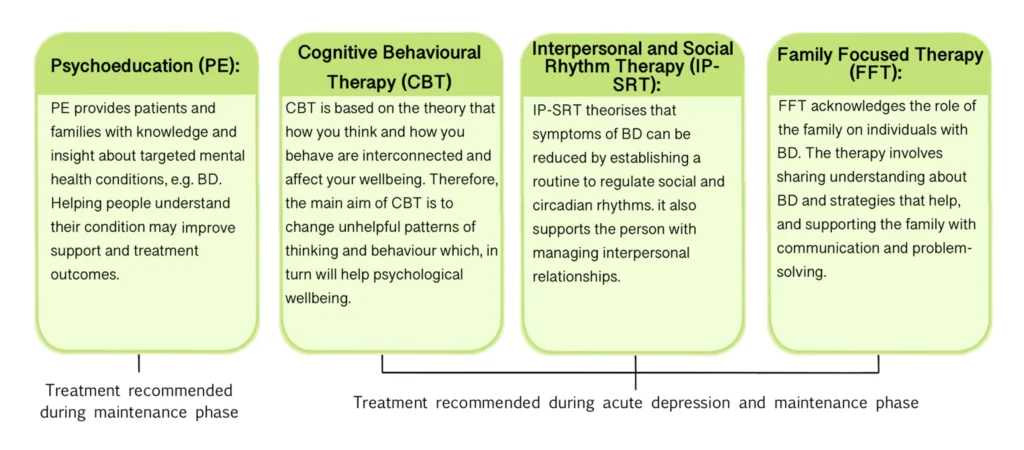
The four treatments below are commonly recommended by national guidelines that use a rigorous method for scrutinising the evidence base and generating recommendations (Ravitz et al. 2024).
Please note, the existing evidence base supports the effectiveness of these therapies in addition to usual medication; very little research has looked at psychological therapies as an alternative to medication.
Resources and training for evidence-based psychological interventions
Below are links to sets of resources for each of the four approaches above.
Each set of resources includes the following:
Therapy manuals: details of at least one therapy manual underpinning the approaches. These manuals may be considered “evidence-based” in the sense that they have been used in at least one clinical trial that found evidence for the effectiveness of the therapy.
Clinician training resources: clinician-facing educational websites and modules that could help you understand and apply skills and components from these evidence-based treatments. These do not replace formal training in these approaches, as necessary dependent on your role and location.
Additional resources: these include measures, details of therapy skills, and patient-facing materials such as worksheets, books, and modules.
Click on each resource name to access links
Cognitive Behavioural Therapy (CBT) Resources
Interpersonal and Social Rhythm Therapy (IPSRT) Resources
Family Focused Therapy (FFT) Resources
Recommended Guidelines
United States
American Psychological Association Professional Practice Guidelines
Australia and New Zealand
Canada
Germany
Great Britain
National Institute for Health and Care Excellence (NICE) Guidelines
British Association for Psychotherapy (BAP) Evidence-Based Guidelines for Treating Bipolar Disorder
The Netherlands
GGZ Standaarden Guidelines for Treating Bipolar Disorder (please note this resource is in Dutch)
International Guidelines
World Health Organization (WHO): The following guideline has been developed to apply globally. Most items are not specific to supporting individuals with bipolar disorder, but may provide useful guidance for supporting individuals with severe or complex mental health difficulities in low resource settings.
WHO Mental Health Gap Action Programme (mhGAP)
Psychological Interventions for Older Adults with Bipolar Disorder (OABD)
The ISBD OABD Task Force compiled and compared recommendations form current national and international guidelines that specifically address older people with bipolar disorder. There were 34 guidelines, the majority has no separate section for the OABD population.
There are no large-scale trials specifically examining psychological therapies for older individuals with bipolar disorder. Tyler and Warner’s (2025) paper reports on some smaller trials and outlines various adaptations made to psychological therapies for older adults with bipolar disorder.
Psychological Interventions for Children and Adolescents with Bipolar Disorder
Most clinical guidelines recommend psychological interventions as part of treatment for children and adolescents with bipolar disorder, typically alongside medication. However, few provide detailed, youth-specific guidance, and recommendations are often adapted from adult treatments. While only a limited number of randomized controlled trials (RCTs) have been conducted in this age group, existing studies suggest that developmentally adapted interventions – such as family-focused therapy and psychoeducation – can improve symptoms, functioning, and reduce relapse risk. Early intervention is also widely recommended to improve long-term outcomes. There is a strong emphasis on involving families in treatment.
What about other types of therapies or problems?
If a particular therapy is not included on the list above, this does not necessarily mean it could never be helpful, or that there is no evidence for its effectiveness. We have listed above the therapies with the greatest evidential support at the time of writing.
In the general population there are therapies that have been shown to be effective for a variety of issues such as stress, reactions to trauma, and various mental health conditions. Whilst these may not have been directly tested in people with bipolar disorder, it is reasonable to expect that they could be helpful for people with bipolar disorder who experience these issues. What is important to consider is that the therapist or clinician should have knowledge about and experience in working with people with bipolar disorder.

Contributors
This resource was created by the ISBD Pyshcological Interventions Task Force. We would like to acknowledge the workgroup that led this project:
- Kim Wright (UK)
- Ruth Anning (UK)
- Harriet Birabwa (Uganda)
- Tatiana Cohab Khafif (Brazil)
- Emma Morton (Australia)
- Halla Ólafsdóttir (Iceland)
- Hailey Tremain (Australia)
- Elizabeth Tyler (UK)
- Andrea Vassilev (USA)
We welcome feed back
Please CLICK HERE to complete our feedback survey! Thank you